# Time class, carry, don't understand how it works exactly

**URL:** https://discourse.processing.org/t/time-class-carry-dont-understand-how-it-works-exactly/17098
**Category:** Coding Questions
**Created:** [January 15, 2020, 5:31pm UTC](https://discourse.processing.org/t/time-class-carry-dont-understand-how-it-works-exactly/17098 "2020-01-15T17:31:03Z")
**Posts on this page:** 3
**Page:** 1

<div class="post-metadata">

### Author: ![ddownn](https://yyz2.discourse-cdn.com/flex036/user_avatar/discourse.processing.org/ddownn/32/2731_2.png) [@ddownn](https://discourse.processing.org/u/ddownn)
#### Post date: [January 15, 2020, 5:31pm UTC](https://discourse.processing.org/t/time-class-carry-dont-understand-how-it-works-exactly/17098/1 "2020-01-15T17:31:04Z")

</div>

I need help understanding how the pre() function in this Time class works.

Edit: I think maybe I have it, does this seem sound? So far it seems to be working.

The thing I don’t like about this is that I made it work by just dividing `milli / 100` and then setting the value of `milli %= 100`. It does get the tenths, but then `milli` is no longer truly the value of milliseconds, so when I use this in my Time class, anywhere where `milli` is used, such as getting angles for smooth clock hand rotations, it’s no longer correct.

Where I am really stuck is how to add the ability to get 1/10sec in-line with this code without affecting the value of `milli` from one loop to the next.

I’ve updated the code with comments about my understanding of how this works, and which parts I don’t understand.

```auto

int lastT, deltaT, carry, milli, hundredths, tenths, sec, min, hr;
String carry100msStr, carry10msStr, carry60secStr, carry60minStr;
void setup() {
   size(400, 600);
   
   lastT = millis();
   milli = 0;
   hundredths = 0;
   tenths = 0;
   sec = second();
   min = minute();
   hr = hour();
}

void draw() {
   background(127);
   
   int rightNow = millis();
   deltaT = rightNow - lastT; 
   lastT = rightNow;
   milli += deltaT; // get the baseUnit count i.e. "milli"
   carry = 0;
   
   // the baseUnit can be as high as 1000
   // the next unit is tenths, and we need just 100 baseUnits for one "tenth"
   // divide the baseUnit count by how many you need for the next unit: floor(milli / 100)
   // if there is not enough yet, this will be '0'
   // if there are enough baseUnits so far, carry 1
   carry = floor(milli / 100);
   
   // not sure how to describe this
   // but I see if I don't use "milli %= 1000" then milli will not count properly on the next loop
   // and if I do use "milli %= 1000" then it also fails but I don't know why. 
   milli %= 1000;
   
   // add "1" or "0" to the next unit, "tenths"
   tenths += carry;
   
   // need 10 of these before incrementing the next unit, "sec"
   carry = floor(tenths / 10);
   
   // not sure how to describe this
   tenths %= 10;
   
   // add "1" or "0" to the next unit, "sec"
   sec += carry;
   
   // need 60 of these before incrementing the next unit, "min"
   carry = floor(sec / 60); 
   
   // not sure how to describe this
   sec %= 60;
   
   // add "1" or "0" to the next unit, "min"
   min += carry;
   
   // need 60 of these before incrementing the next unit, "hr"
   carry = floor(min / 60);
   
   // not sure how to describe this
   min %= 60;
   
   // add "1" or "0" to the next unit, "hr"
   hr += carry;
   
   // not sure how to describe this
   hr %= 24;
   
   String milliStr = nf(milli, 2) + " milli";
   String tenthsStr = nf(tenths, 1) + " tenths";
   String secStr = nf(sec, 2) + " seconds";
   String minStr = nf(min, 2) + " minutes";
   String hrStr = nf(hr, 2) + " hr";
   
   String[] list = {
      
      milliStr, 
      tenthsStr,
      secStr,
      minStr, 
      hrStr
      
   };
   
   showTextArrayLeft(list);
}

void showTextArrayLeft(String[] strings) {
   
   float textH = 18;
   //textFont(mono);
   textSize(textH);
   textAlign(LEFT, TOP);
   fill(0);
   for (int i=0; i<strings.length; i++) {
      text(strings[i], 5, 5 + i * textH);
   }
}

```

> **Previous question**
>
> I feel like I can follow the logic and it makes sense, but I have been trying to interpolate a way to include a value for tenths of a second in line with the existing logic and I just don’t understand why it’s not working, so I guess I have to admit I do t really understand why it works.  
> Could someone please comment on the class pre() function and show me how I would add an extra step to get the tenths of a second in between milli and second, and tell me why my attempt is not working? I would really appreciate it.  
> In this sketch I’m not actually using the Time class, I pulled out the parts to just work in the draw() loop.

> **Previous code**
>
> ```auto
> int lastT, deltaT, carry, milli, tenths, sec;
> void setup() {
> size(400, 600);
>    
> lastT = millis();
> milli = 0;
> tenths = 0;
> sec = second();
> }
> 
> void draw() {
> background(127);
>    
> int rightNow = millis();
> deltaT = rightNow - lastT; 
> lastT = rightNow;
> milli += deltaT;
> carry = 0;
>    
> tenths = floor(milli / 100);
> String tenthsStr1 = nf(tenths, 1);
>    
> carry = floor(tenths / 10);
> String carryStr = nf(carry, 1);
>    
> tenths %= 10;
> String tenthsStr2 = nf(tenths, 1);
>    
> sec += carry;
> sec %= 60;
>    
> String secStr = nf(sec, 2);
>    
> String[] list = {
>       
> tenthsStr1,
> tenthsStr2,
> carryStr,
> secStr
>       
> };
>    
> showTextArrayLeft(list);
> }
> 
> void showTextArrayLeft(String[] strings) {
>    
> float textH = 18;
> //textFont(mono);
> textSize(textH);
> textAlign(LEFT, TOP);
> fill(0);
> for (int i=0; i<strings.length; i++) {
> text(strings[i], 5, 5 + i * textH);
> }
> }
> 
> public class Time {
> private int lastT;
> private int deltaT;
> private int hour, minute, second, tenth, milli;
>    
> private final float ANGLE_OFFSET = - PI /2;
>    
> private final float ANGLE_HOUR = TWO_PI / 12;
> private final float ANGLE_MINUTE = TWO_PI / 60;
> private final float ANGLE_SECOND = TWO_PI / 60;
>    
> Time(int h, int m, int s) {
> hour = h;
> minute = m;
> second = s;
> tenth = 0;
> milli = 0;
> lastT = millis();
> deltaT = 0;
> }
>    
> public void pre() {
> // Get the elapsed time since the last draw method
> int carry = 0;
> int now = millis();
> deltaT = now - lastT; 
> lastT = now;
> milli += deltaT;
>       
> carry = floor(milli / 1000); // integer division
> milli %= 1000;
>       
> tenth = floor(milli / 100);
>       
> second += carry;
> carry = floor(second / 60); // integer division
> second %= 60;
>       
> minute += carry;
> carry = floor(minute / 60); // integer division
> minute %= 60;
>       
> hour += carry;
> hour %= 24;
> }
>    
> int getHour() {
> return hour;
> }
>    
> float getHourHandAngle() {
> float t = (hour % 12) + (minute / 60f) + (second / 3600f) + (milli/ 3600000f);
> return t * ANGLE_HOUR + ANGLE_OFFSET;
> }
>    
> int getMinute() {
> return minute;
> }
>    
> float getMinuteHandAngle() {
> float t = minute + (second / 60f) + (milli / 60000f);
> return t * ANGLE_MINUTE + ANGLE_OFFSET;
> }
>    
> int getSecond() {
> return second;
> }
>    
> float getSecondHandAngle() {
> float t = second + (milli / 1000f);
> return t * ANGLE_SECOND + ANGLE_OFFSET;
> }
>    
> int getTenth() {
> return tenth;
> }
>    
> int getMilli() {
> return milli;
> }
>    
> public String toString() {
> return getHour() + ":" + getMinute() + ":" + getSecond() + "." + milli;
> }
> }
> 
> ```

---

<div class="post-metadata">

### Author: ![kll](https://yyz2.discourse-cdn.com/flex036/user_avatar/discourse.processing.org/kll/32/964_2.png) [@kll](https://discourse.processing.org/u/kll)
#### Post date: [January 17, 2020, 2:40am UTC](https://discourse.processing.org/t/time-class-carry-dont-understand-how-it-works-exactly/17098/2 "2020-01-17T02:40:36Z")

</div>

generally you could do the date / time by

read: date time at start of program

and from then on use the millis() ( counting from start )  
to make your own TIME.  
and there are many examples…

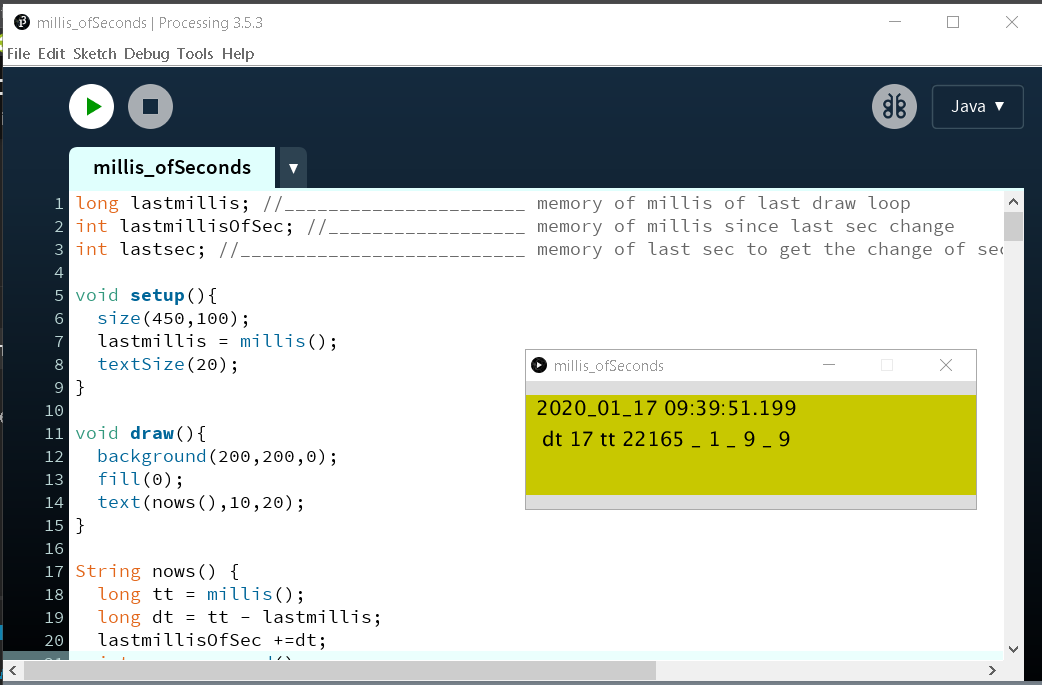
if you not need a very exact way / just a divider of the system seconds / into msec  
you could use the millis Of This Second ( with a ERROR of possible 1/60= 17 msec )

```auto
long lastmillis; // ______________________ memory of millis of last draw loop
int lastmillisOfSec; // __________________ memory of millis since last sec change
int lastsec; // __________________________ memory of last sec to get the change of sec. ( ERROR by 'dt' WITH 60 FPS / 17msec )

void setup(){
  size(450,100);
  textSize(20);
}

void draw(){
  background(200,200,0);
  fill(0);
  text(nows(),10,20);
}

String nows() {
  long tt = millis();
  long dt = tt - lastmillis;
  lastmillisOfSec +=dt;
  int sec = second();
  if ( sec != lastsec ) { // _____________ new second / reset sec millis
     lastmillisOfSec = 0; // _____________ this can be 'dt' millis late
     lastsec = sec;
  }
  lastmillis = tt; // ____________________ last draw run
  String thismillis = nf(lastmillisOfSec,3);
  return ""+year()+"_"+nf(month(), 2)+"_"+nf(day(), 2)+" "+nf(hour(), 2)+":"+nf(minute(), 2)+":"+nf(second(), 2)+"."+thismillis+
  "\n dt "+dt+" tt "+tt+" _ "+thismillis.charAt(0)+" _ "+thismillis.charAt(1)+" _ "+thismillis.charAt(2);
}

```
 ![millisOfSecond](https://canada1.discourse-cdn.com/flex036/uploads/processingfoundation1/original/2X/6/6f79a85c45f6de1448cde0e7c2c8dc32039c842f.png)

---

<div class="post-metadata">

### Author: ![ddownn](https://yyz2.discourse-cdn.com/flex036/user_avatar/discourse.processing.org/ddownn/32/2731_2.png) [@ddownn](https://discourse.processing.org/u/ddownn)
#### Post date: [January 17, 2020, 12:52pm UTC](https://discourse.processing.org/t/time-class-carry-dont-understand-how-it-works-exactly/17098/3 "2020-01-17T12:52:26Z")

</div>

I’m mostly interested in learning how to make the algorithm do what I want it to do, or understanding it well enough to know if it can’t. The idea of taking parts away and carrying some to the next part looks like a tree of dividing a number into separate parts, and I want to understand how to add more branches without breaking the way it works.
