# "Small Universes" : Pattern hunting with the Wolfram Physics Project
**URL:** https://discourse.processing.org/t/small-universes-pattern-hunting-with-the-wolfram-physics-project/24001
**Category:** Gallery
**Created:** [September 21, 2020, 12:52pm UTC](https://discourse.processing.org/t/small-universes-pattern-hunting-with-the-wolfram-physics-project/24001 "2020-09-21T12:52:33Z")
**Posts on this page:** 14
**Page:** 1
### Author:  [@solub](https://discourse.processing.org/u/solub)
#### Post date: [September 21, 2020, 12:52pm UTC](https://discourse.processing.org/t/small-universes-pattern-hunting-with-the-wolfram-physics-project/24001/1 "2020-09-21T12:52:33Z")
Hi everyone,
A couple of days ago I came across this fascinating [interview](https://www.youtube.com/watch?v=-t1_ffaFXao) of Stephen Wolfram where he addressed the different concepts arising from his latest and most promising project: the [Wolfram Physics Project](https://writings.stephenwolfram.com/2020/04/finally-we-may-have-a-path-to-the-fundamental-theory-of-physics-and-its-beautiful/). If you are curious about how his Theory of Everything relates to physics, quantum computation or the origin of life I highly recommend having a look at the short clips available on Lex Fridman’s [channel](https://www.youtube.com/c/LexClips/videos), they are much easier to digest than the whole +3h interview.
Among the different topics covered I was particularly interested in the central notion of [hypergraphs](https://www.youtube.com/watch?v=YGNaRFEa8PI&t=1s) and their visual aesthetics in 3D space.
[https://s1.gifyu.com/images/ezgif-3-26edb515b68b.gif](https://s1.gifyu.com/images/ezgif-3-26edb515b68b.gif)
From what I understand these graphs are similar to Cellular Automaton in that they follow a discrete model of computation but are also reminiscent of the Lindenmayer L-Systems because of the [rewriting system](https://en.wikipedia.org/wiki/Rewriting) they are built on. Those who are familiar with these types of algorithms (and I know there are many inside the Processing community) will easily catch up with this new model as it mainly consists in applying a rule over and over again until it produces something that looks really complicated.
[ ](https://www.youtube.com/watch?v=o9jBUMLr6hY&t=21)
What I find particulariy fascinating is not only the complexity that emerges from simple rules but also the remarkable diversity of hypergraphs that it can produce. Without any notion of geometry the rewriting system can yet lead to various looking shapes in 2D and 3D space: trees, open/closed networks, meshes, reticular systems, Sierpiński structures,…etc.

Like for Cellular Automata, the Wolfram community is keeping a [registry](https://www.wolframphysics.org/universes/index.html) of the notable “universe” models (as they call them) found so far with their corresponding rules. Here is a naive interpretation in Python mode of the first and most popular example used by Stephen Wolfram in his presentations.
> **Hypergraph Example (Python Mode)**
>
> ```auto
> from collections import defaultdict
> from itertools import chain
> add_library('toxiclibs')
> add_library('peasycam')
>
> W, H = 1400, 800
>
> ####### Multiple relations example (see part 2.7)
> ####### -> https://www.wolframphysics.org/technical-introduction/basic-form-of-models/rules-depending-on-more-than-one-relation/
>
> # RULE (if edges corresponding to pattern 'a' -> replace by new edges corresponding to pattern 'b')
> a = [[0, 1], [0, 2]]
> b = [[0, 2], [0, 3], [1, 3], [2, 3]]
>
> # Starting axiom
> s = [[0, 0], [0, 0]]
>
> # Number of steps/generations
> G = 13
>
> def setup():
> size(W, H, P3D)
> stroke(105, 140, 200)
> smooth(8)
>
> global physics, uniques, a, b, s
>
> cam = PeasyCam(this, 1000)
> physics = VerletPhysics3D()
> physics.setDrag(.2)
>
>
> #Transform / Translate axiom according to rule
> a_,b_,s_ = [list(chain(*e)) for e in (a,b,s)]
> ws = set(k for k in b_ if k > max(a_))
>
> while ws:
> a_ += [ws.pop()]
> s_ += [max(s_)+1]
>
> d = {k:i for i, k in enumerate(a_)}
> t = [map(lambda x: s_[d[x]], e) for e in b]
>
> print "Translated axiom: ", t
>
> #Finding matching relations in the array of edges
> for g in xrange(G-1):
> temp = []
> ids = set()
> w = max(chain(*t))+1
>
> #This part (until line 66 + line 70) should be modified depending on the input rule
> for i, (xa, ya) in enumerate(t):
> for j, (xb, yb) in enumerate(t):
> if i != j:
> if xa == xb and yb > ya: # reminder: [[xa, xb], [ya, yb]] = [[0, 1], [0, 2]]
> if {i, j}.isdisjoint(ids):
> temp.append((xa, ya, xb, yb))
> ids.update([i, j])
>
> for id in sorted(ids, reverse=True): del t[id]
>
> for xa, ya, xb, yb in temp[::-1]:
> t.extend([[xa, yb], [xa, w], [ya, w], [yb, w]])
> w += 1
>
>
>
> #Get id of each node
> uniques = list(set(chain(*t)))
>
> print "Hypergraph after %.i steps: %.i nodes // %.i edges" % (G, len(uniques), len(t))
>
> #Store neighboring nodes for each node in a dictionary (handle both binary and ternary edges)
> d = defaultdict(set)
> for edge in t:
> n = len(edge)
> if n == 2:
> n1, n2 = edge
> d[n1].add(n2)
> d[n2].add(n1)
> elif n == 3:
> n1, n2, n3 = edge
> d[n1].add(n2)
> d[n3].add(n2)
> d[n2].update([n1, n3])
> else:
> pass
>
> #Find smallest and largest number of neighbors (not mandatory, using this for computing edge length later)
> nn = sorted(len(d[k]) for k in d)
> lo, hi = nn[0], nn[-1]+1
>
>
> #Create a particle for each node + give it a repulsion force
> for n in uniques:
> p = VerletParticle3D(Vec3D.randomVector().scale(W).add(Vec3D(W>>1, H>>1, 0)))
> physics.addParticle(p)
> physics.addBehavior(AttractionBehavior3D(p, 200, -.5))
>
> #Create spring between each pair of nodes (handle both binary and ternary edges)
> for edge in t:
> n = len(edge)
> if n == 2:
> n1, n2 = edge
> p1, p2 = [physics.particles.get(uniques.index(n)) for n in edge]
> l = ( len(d[n1]) + len(d[n2]) ) * .5 # make length of edge depend on the average number of neighbors of its end vertices
> f = map(l, lo, hi, 1, .3) #the higher the degree of the end vertices, the lower the factor
> s = VerletSpring3D(p1, p2, l*l*f, .3)
> physics.addSpring(s)
> elif n == 3:
> n1, n2, n3 = edge
> p1, p2, p3 = [physics.particles.get(uniques.index(n)) for n in edge]
> l1 = ( len(d[n1]) + len(d[n2]) ) * .5
> l2 = ( len(d[n2]) + len(d[n3]) ) * .5
> f1 = map(l1, lo, hi, 1, .2)
> f2 = map(l2, lo, hi, 1, .2)
> s1 = VerletSpring3D(p1, p2, l1*l1*f1, .2)
> s2 = VerletSpring3D(p2, p3, l2*l2*f2, .2)
> physics.addSpring(s1)
> physics.addSpring(s2)
> else:
> pass
>
>
> def draw():
> background('#000000')
> translate(-W>>1, -H>>1)
>
> #Update physics
> physics.update()
>
> #Draw springs
> for s in physics.springs:
> line(s.a.x(),s.a.y(), s.a.z(), s.b.x(), s.b.y(), s.b.z())
>
> #Draw nodes
> pushStyle()
> strokeWeight(3.5)
> stroke('#BEF0FF')
> for p in physics.particles:
> point(p.x(), p.y(), p.z())
> popStyle()
>
> ```
It works with other rules (pictures above), but you will have to modify lines 59 to 66 according to the pattern you are trying to find.
My hope is that someone will come up with a better implementation in Java mode and share it here for everyone to play with. Who knows, some day one of us might come across an amazing pattern that will be worth including in Wolfram registry !
---
### Author:  [@solub](https://discourse.processing.org/u/solub)
#### Post date: [September 21, 2020, 9:24pm UTC](https://discourse.processing.org/t/small-universes-pattern-hunting-with-the-wolfram-physics-project/24001/3 "2020-09-21T21:24:01Z")
Simpler examples in 2D:
– **rule [WM148](https://www.wolframphysics.org/universes/wm148/)** : `[(x, y)] -> [(x, y), (y, z)]`
```auto
x, y, z = 0, 1, 2
arr = [(x, y)]
steps = 4
for step in xrange(steps):
temp = [] #temporary array to store new pairs of nodes
for i, (x, y) in enumerate(arr):
new_pair = (y, z) #create a new pair connecting 'y' to 'z'
idx = 2*i+1 #compute its future index in array (next generation)
temp.append((new_pair, idx)) #store it with its index
z += 1
[arr.insert(i, p) for p, i in temp] #intertwine previous array with temporary array -> ([x, y], [y, z], [x, y], [y, z],...)
```
or in a more pythonic way:
```auto
for step in xrange(steps):
temp = [(y, z+i+len(arr)-1) for i, (x,y) in enumerate(arr)]
arr = sum(zip(arr, temp),())
```
Then attaching the pairs of nodes with springs using Toxiclibs:

> **Full sketch**
>
> ```auto
> ### A basic implementation of rule WM148 in Python mode ###
> ### doc --> https://www.wolframphysics.org/universes/wm148/ ###
> ### explanation --> https://www.wolframphysics.org/technical-introduction/basic-form-of-models/first-example-of-a-rule/index.html ###
>
> from collections import defaultdict
> add_library('toxiclibs')
>
> W, H = 1000, 600 #dimensions of canvas
> x, y, z = 0, 1, 2
> a = [(x, y)] #starting axiom
> sw = []
>
> def setup():
> size(1000, 600)
>
> global physics, a, sw
>
> # Instantiate Verlet Physics + set drag
> physics = VerletPhysics2D()
> physics.setDrag(.2)
>
> # RULE: [(x, y)] --> [(x, y), (y, z)]
> for step in xrange(11):
> temp = [(y, z+i+len(a)-1) for i, (x,y) in enumerate(a)]
> a = sum(zip(a, temp),())
>
> d = defaultdict(set)
> for n1, n2 in a:
> d[n1].add(n2)
> d[n2].add(n1)
>
> neighbors_count = sorted(len(d[k]) for k in d)
> minl, maxl = neighbors_count[0], neighbors_count[-1]
>
> # Get id of each node
> uniques = set(sum(a, ())) # [0, 1, 2, ..., n]
>
> # Add particle for each node
> for id in uniques:
> p = VerletParticle2D(Vec2D.randomVector().scale(W).add(Vec2D(W>>1, H>>1)))
> physics.addParticle(p)
> physics.addBehavior(AttractionBehavior2D(p, 40, -.5))
>
> # Create spring between each pair of nodes
> for n1, n2 in a:
> p1 = physics.particles.get(n1)
> p2 = physics.particles.get(n2)
> l = (len(d[n1]) + len(d[n2])) * .5
> f = map(l, minl, maxl, 1, 0.1)
> s = VerletSpring2D(p1, p2, l*l*f, .3)
> physics.addSpring(s)
>
> w = l*l*.015
> sw.append(w)
>
>
>
> def draw():
> background('#FFFFFF')
>
> physics.update() #update physics
>
> #Draw springs + nodes
> for i, s in enumerate(physics.springs):
> strokeWeight(sw[i])
> line(s.a.x(), s.a.y(), s.b.x(), s.b.y())
>
> pushStyle()
> strokeWeight(2)
> for p in physics.particles:
> point(p.x(), p.y())
> popStyle()
>
> ```
– **rule [WM686](https://www.wolframphysics.org/universes/wm686/)** : `[(x, y)] --> [(y, z), (z, x)]`
This rule can be used as a simple circle growth algorithm if we update only one pair per iteration (instead of the whole stack)

> **Full sketch**
>
> ```auto
>
> ### How rule WM686 can be used as a circle growth algorithm ###
> ### doc --> https://www.wolframphysics.org/universes/wm686/ ###
>
> add_library('toxiclibs')
>
> W, H = 1000, 600 #dimensions of canvas
> a = [(0, 1), (0, 2), (1, 2)] #starting axiom
> z = max(sum(a,()))+1 #total number of edges AND the id of the next node to add
>
> def setup():
> size(W, H)
>
> global physics
>
> # Instantiate Verlet Physics + set drag
> physics = VerletPhysics2D()
> physics.setDrag(.2)
>
> # Get id of each node
> uniques = set(sum(a, ())) # [0, 1, 2]
>
> # Add particle for each node
> for id in uniques:
> p = VerletParticle2D(Vec2D.randomVector().add(Vec2D(W>>1, H>>1)))
> physics.addParticle(p)
> physics.addBehavior(AttractionBehavior2D(p, 10, -.5))
>
> # Create spring between each pair of nodes
> for n1, n2 in a:
> p1 = physics.particles.get(n1)
> p2 = physics.particles.get(n2)
> s = VerletSpring2D(p1, p2, 4, .5)
> physics.addSpring(s)
>
>
> def draw():
> background('#FFFFFF')
>
> global z
>
> physics.update() #update physics
>
> # Process rule: [(x, y)] --> [(y, z), (z, x)]
> id = int(random(z)) #pick an edge at random
> x, y = a[id] #coordinates of selected edge
> del a[id] #remove edge
> a.extend([(y, z), (z, x)]) #add 2 new edges according to replacement rule
>
> # Manage physics accordingly
> px = physics.particles.get(x) #coordinate of node x
> py = physics.particles.get(y) #coordinate of node y
> pz = VerletParticle2D(px.add(py).scale(.5)) #create a new particle in between
>
> s = physics.getSpring(px, py) #find spring between the deleted edge
> physics.removeSpring(s) #remove that spring
>
> physics.addParticle(pz) #add particle
> physics.addBehavior(AttractionBehavior2D(pz, 10, -.5)) #attach a repulsion behavior to it
>
> s1 = VerletSpring2D(py, pz, 4, .5) #create spring between 1st new edge
> s2 = VerletSpring2D(pz, px, 4, .5) #create spring between 2nd new edge
> physics.addSpring(s1) #add them to physics
> physics.addSpring(s2)
>
> z += 1 #increment 'z'
>
>
> #Draw springs
> for s in physics.springs:
> line(s.a.x(), s.a.y(), s.b.x(), s.b.y())
>
> ```
---
### Author:  [@solub](https://discourse.processing.org/u/solub)
#### Post date: [September 22, 2020, 11:53pm UTC](https://discourse.processing.org/t/small-universes-pattern-hunting-with-the-wolfram-physics-project/24001/4 "2020-09-22T23:53:41Z")
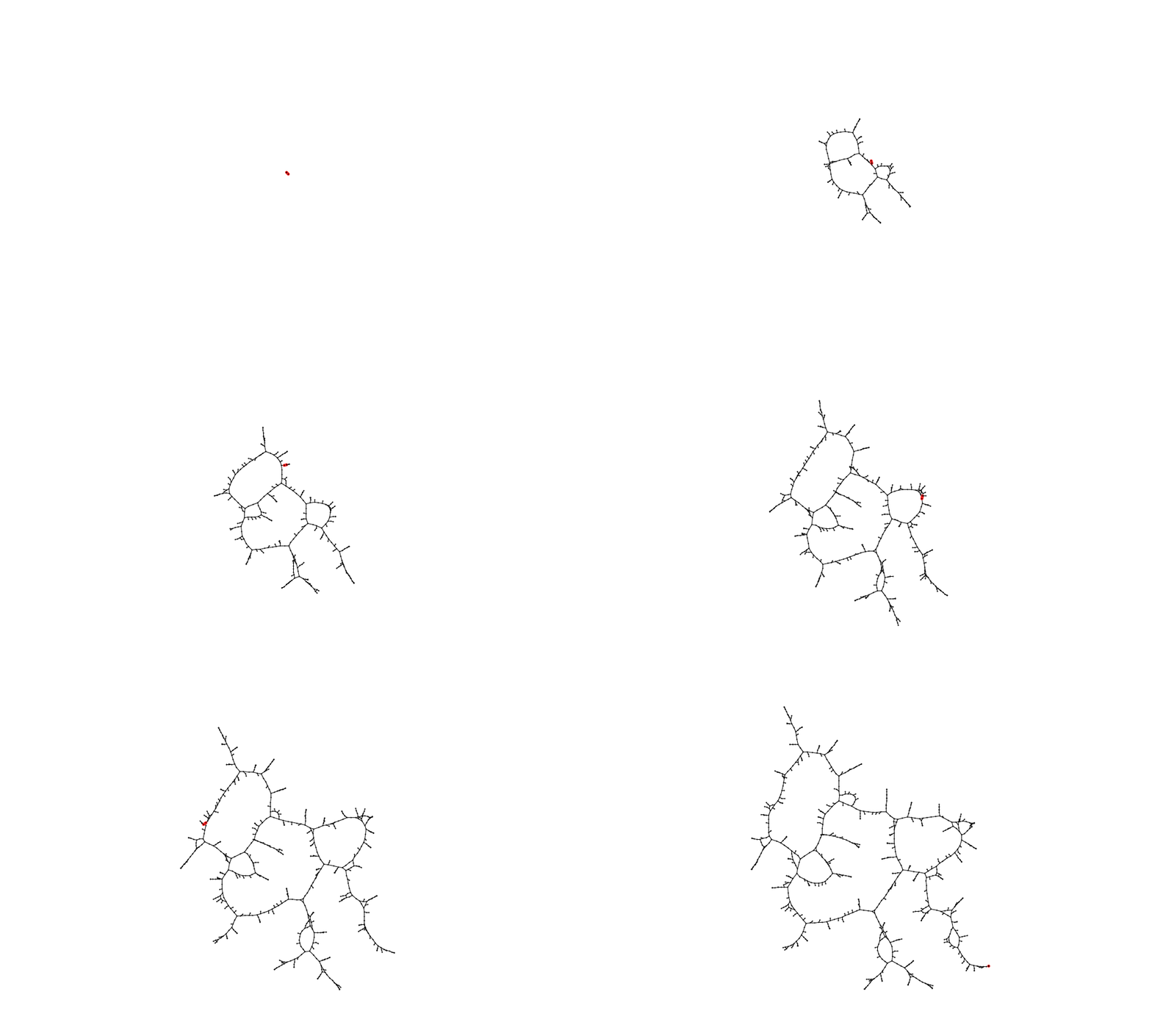
Same sketch with different rules. I like the idea to randomly select a matching pair at each time step rather than to update the whole stack at once. This opens the way to a wider range of patterns and allows to address the model as some sort of a growth system.
- Rule [WM2695](https://www.wolframphysics.org/universes/wm2695/) mixed with some random rule that creates loops at regular intervals
[ ](https://s1.gifyu.com/images/ezgif-2-4067d49ebb1a.gif)
- Sierpiński patterns with rule [WM97655](https://www.wolframphysics.org/universes/wm97655/)
[ ](https://s1.gifyu.com/images/ezgif-2-00befe962056.gif)
- Mesh knitting with rule [WM7714](https://www.wolframphysics.org/universes/wm7714/)
[ ](https://s1.gifyu.com/images/ezgif-2-d36083757b6b.gif)
---
### Author:  [@paulgoux](https://discourse.processing.org/u/paulgoux)
#### Post date: [September 23, 2020, 1:24am UTC](https://discourse.processing.org/t/small-universes-pattern-hunting-with-the-wolfram-physics-project/24001/5 "2020-09-23T01:24:59Z")
I’ve done what I can to get started however I know little about python, so I’ve left out the parts I did not understand.
```auto
//add_library('toxiclibs')
import toxiclibs*;
//add_library('peasycam')
import peasycam*;
//Capture cam;
int W, H = 1400, 800;
//####### Multiple relations example (see part 2.7)
//####### -> https://www.wolframphysics.org/technical-introduction/basic-form-of-models/rules-depending-on-more-than-one-relation/
//# RULE (if edges corresponding to pattern 'a' -> replace by new edges corresponding to pattern 'b')
int [][] a = {{0,1}},{0,2}};
//[[0, 1], [0, 2]]
int [][] b = {{0,3}},{0,3},{1,3},{2,3}};
//[[0, 2], [0, 3], [1, 3], [2, 3]]
# Starting axiom
int s = {{0,0}},{0,0}};
//s = [[0, 0], [0, 0]]
# Number of steps/generations
int G = 13;
void setup(){
size(W, H, P3D);
stroke(105, 140, 200);
smooth(8);
//not sure of type
global physics, uniques, a, b, s;
cam = PeasyCam(this, 1000);
physics = VerletPhysics3D();
physics.setDrag(.2);
//#Transform / Translate axiom according to rule
//--------------------------------------------------------
a_,b_,s_ = [list(chain(*e)) for e in (a,b,s)]
ws = set(k for k in b_ if k > max(a_));
//--------------------------------------------------------
// not sure where for loop ends
while (ws){
a_ += [ws.pop()]
s_ += [max(s_)+1]
}
//---------------------------------------------------what does this do?
// its a for loop but what is happening to d, is t in the for loop?
//for(int i=k;i ya: # reminder: [[xa, xb], [ya, yb]] = [[0, 1], [0, 2]];
if {i, j}.isdisjoint(ids){
temp.append((xa, ya, xb, yb));
ids.update([i, j]);
}}
// del ?? also unusual for loop
for (id in sorted(ids, reverse=True)) del t[id];
// what does temp[::-1] do?
for (xa, ya, xb, yb in temp[::-1]){
// extend ??
t.extend([[xa, yb], [xa, w], [ya, w], [yb, w]]);
w += 1
}
//#Get id of each node
// what is list ?
uniques = list(set(chain(*t)));
print ("Hypergraph after %.i steps: %.i nodes // %.i edges" % (G, len(uniques), len(t)));
//#Store neighboring nodes for each node in a dictionary (handle both binary and ternary edges)
// what is java equiv of dictionary?
d = defaultdict(set);
for (edge in t){
n = len(edge);
if (n == 2)
n1, n2 = edge;
d[n1].add(n2);
d[n2].add(n1);
else if (n == 3){
n1, n2, n3 = edge;
d[n1].add(n2);
d[n3].add(n2);
d[n2].update([n1, n3]);
}else pass;
}
#Find smallest and largest number of neighbors (not mandatory, using this for computing edge length later)
nn = sorted(len(d[k]) for k in d)
lo, hi = nn[0], nn[-1]+1
#Create a particle for each node + give it a repulsion force
for (n in uniques){
// not sure about >>
p = VerletParticle3D(Vec3D.randomVector().scale(W).add(Vec3D(W>>1, H>>1, 0)));
physics.addParticle(p);
physics.addBehavior(AttractionBehavior3D(p, 200, -.5));
}
#Create spring between each pair of nodes (handle both binary and ternary edges)
for( edge in t){
n = len(edge);
if n == 2:
n1, n2 = edge
p1, p2 = [physics.particles.get(uniques.index(n)) for n in edge]
l = ( len(d[n1]) + len(d[n2]) ) * .5 # make length of edge depend on the average number of neighbors of its end vertices
f = map(l, lo, hi, 1, .3) #the higher the degree of the end vertices, the lower the factor
s = VerletSpring3D(p1, p2, l*l*f, .3)
physics.addSpring(s)
else if (n == 3){
n1, n2, n3 = edge;
p1, p2, p3 = [physics.particles.get(uniques.index(n)) for n in edge];
l1 = ( len(d[n1]) + len(d[n2]) ) * .5;
l2 = ( len(d[n2]) + len(d[n3]) ) * .5;
f1 = map(l1, lo, hi, 1, .2);
f2 = map(l2, lo, hi, 1, .2);
s1 = VerletSpring3D(p1, p2, l1*l1*f1, .2);
s2 = VerletSpring3D(p2, p3, l2*l2*f2, .2);
physics.addSpring(s1);
physics.addSpring(s2);
}else pass
}
}
void draw(){
background(0);
// >>????
translate(-W>>1, -H>>1);
//#Update physics
physics.update();
//#Draw springs
for (s in physics.springs)line(s.a.x(),s.a.y(), s.a.z(), s.b.x(), s.b.y(), s.b.z());
//#Draw nodes
pushMatrix();
strokeWeight(3.5);
stroke(0);
for (p in physics.particles){
point(p.x(), p.y(), p.z());
}
popMatrix();
};
```
---
### Author:  [@monkstone](https://discourse.processing.org/u/monkstone)
#### Post date: [September 23, 2020, 9:09am UTC](https://discourse.processing.org/t/small-universes-pattern-hunting-with-the-wolfram-physics-project/24001/6 "2020-09-23T09:09:13Z")
@paulgoux @solub Just for a laugh I translated the circle growth algorithm sketch to JRubyArt:-
```ruby
require 'toxiclibs'
W = 1000
H = 600
attr_reader :axiom, :z, :physics
def settings
size(W, H)
end
def setup
sketch_title 'Wolfram Circle Growth'
@axiom = [[0, 1], [0, 2], [1, 2]]
@z = axiom.flatten.max + 1
@physics = Physics::VerletPhysics2D.new
physics.set_drag(0.2)
# Get id of each node
uniques = axiom.flatten.uniq
uniques.each do
p = Physics::VerletParticle2D.new(TVec2D.randomVector.add(TVec2D.new(W >> 1, H >> 1)))
physics.addParticle(p)
physics.addBehavior(Physics::AttractionBehavior2D.new(p, 10, -0.5))
end
axiom.each do |node|
p1 = physics.particles.get(node[0])
p2 = physics.particles.get(node[1])
s = Physics::VerletSpring2D.new(p1, p2, 4, 0.5)
physics.add_spring(s)
end
end
def draw
background(color('#FFFFFF'))
physics.update
node = axiom.sample # random node
x, y = *node # splat node
axiom.delete node
axiom << [y, z]
axiom << [z, x]
# Manage physics accordingly
px = physics.particles.get(x) # coordinate of node x
py = physics.particles.get(y) # coordinate of node y
pz = Physics::VerletParticle2D.new(px.add(py).scale(0.5)) # create a new particle in between
s = physics.get_spring(px, py) # find spring between the deleted edge
physics.remove_spring(s) # remove that spring
physics.add_particle(pz) # add particle
physics.add_behavior(Physics::AttractionBehavior2D.new(pz, 10, -0.5)) # attach a repulsion behavior to it
s1 = Physics::VerletSpring2D.new(py, pz, 4, 0.5) # create spring between 1st new edge
s2 = Physics::VerletSpring2D.new(pz, px, 4, 0.5) # create spring between 2nd new edge
physics.add_spring(s1) # add them to physics
physics.add_spring(s2)
@z += 1 # increment 'z'
# Draw springs
physics.springs.each do |spring|
line(spring.a.x, spring.a.y, spring.b.x, spring.b.y)
end
end
```
Toxiclibs is available as gem in JRubyArt (TVec2D is used to avoid conflict with JRubyArt Vec2D). I think I will have a go at translating more examples. I wonder if it might be possible to create a generalized approach like with [LSystems](https://monkstone.github.io/LSystems/) in java and [here in JRubyArt](https://github.com/ruby-processing/JRubyArt-examples/tree/master/processing_app/topics/lsystems)?
---
### Author:  [@solub](https://discourse.processing.org/u/solub)
#### Post date: [September 23, 2020, 4:21pm UTC](https://discourse.processing.org/t/small-universes-pattern-hunting-with-the-wolfram-physics-project/24001/7 "2020-09-23T16:21:28Z")
Thank you for the JRubyArt translation. It is always insightful to see how languages compare to each other and I must say that Ruby looks elegant to my eye; at least I find it clear and expressive ( `axiom.flatten.uniq` !)
> [@monkstone](#):
>
> I wonder if it might be possible to create a generalized approach like with LSystems
It should be, but I think there are 2 key aspects that differ from L-Systems and make the implementation of a generalized approach a bit trickier:
- the “interpretation” step
- the search for matching pairs
**1/ Interpretation**
By “interpretation” I mean the initial transformation of the axiom according to the input rule. For example, let’s consider rule [wm2327](https://www.wolframphysics.org/universes/wm2327/):

_(notice how the dimensions of the axiom and its transformation match the dimensions of ‘a’ and ‘b’ respectively)_
If, and only if, the axiom is composed of similar values (0’s in this case, 1’s in Wolfram’s examples) then the translation is relatively simple. In Python:
```auto
m = max(chain(*a)) #max value of 'a' = 4
t = [[i-m if i >= m else 0 for i in l] for l in b] #subtract m to values > m in b
# -> [[1, 2, 1], [3, 1, 0], [0, 1], [0, 4]]
```
However, if the axiom is composed of different non-equal values (I have not yet met this configuration), then we probably need to proceed to a complete remapping based on their indices (logic of the diagram above). In Python:
```auto
s = [[9,4,9], [2,1]]
a_,s_ = [list(chain(*e)) for e in (a,s)]
m = max(a_)
d = {k:i for i, k in enumerate(a_)}
t = [[s_[d[i]] if i in d else i-m for i in l] for l in b]
# -> [[1, 2, 1], [3, 1, 2], [9, 1], [2, 4]]
```
This routine should handle sub-arrays of any size. In this case we have one sub-array of size 3 and one sub-array of size 2 (1 **2** 1 **3** ), but it could be five sub-arrays of size 4 (5 **4** ) or two sub-arrays of size 1 + three sub-arrays of size 2 (2 **1** 3 **2** ), … etc.
**2/ Matching pairs**
So far I have been using `for` loops to find matching pairs but this naive approach turns out to be very costly when the ‘a’ part of the rule (the pattern) has more than 2 sub-arrays. Since each sub-array accounts for an additional nested loop, the time complexity of this method (`O(n^k)` where `k` is the number of sub-arrays), becomes an issue.
For example, let’s consider the pattern of rule [wm97655](https://www.wolframphysics.org/universes/wm97655/) (cf. 2nd gif in my previous post): `a = [[1, 2], [1, 3], [1, 4]]` or put differently `[[a, b], [a, c], [a, d]]`
To find this pattern I had to iterate over the collection of pairs at 3 levels:
```auto
for i, (a1, b) in enumerate(pairs):
for j, (a2, c) in enumerate(pairs):
for k, (a3, d) in enumerate(pairs):
if i != j != k:
if a1==a2==a3 and b
### Author:  [@jeremydouglass](https://discourse.processing.org/u/jeremydouglass)
#### Post date: [September 24, 2020, 10:06pm UTC](https://discourse.processing.org/t/small-universes-pattern-hunting-with-the-wolfram-physics-project/24001/8 "2020-09-24T22:06:59Z")
> [@solub](#):
>
> From what I understand these graphs are similar to Cellular Automaton in that they follow a discrete model of computation but are also reminiscent of the Lindenmayer L-Systems because of the [rewriting system](https://en.wikipedia.org/wiki/Rewriting) they are built on
@solub –
Thanks for sharing this very interesting rendering, and pointing us towards this material.
A matching and rewriting language for hypergraph edges is a very interesting project to implement from scratch. I’ll just note as an aside that another possible approach (untested!) would be to use the Wolfram client for Python, which is Python2 compatible and so might work in Processing.py
> **[GitHub - WolframResearch/WolframClientForPython: Call Wolfram Language...](https://github.com/WolframResearch/WolframClientForPython)**
>
> Call Wolfram Language functions from Python. Contribute to WolframResearch/WolframClientForPython development by creating an account on GitHub.
…and use that to access their project set replacement tools directly, which are implemented as c++ libraries for a Wolfram Language extension here: [GitHub - maxitg/SetReplace: C++/Wolfram Language package for exploring set and graph rewriting systems](https://github.com/maxitg/SetReplace)
---
### Author:  [@jeremydouglass](https://discourse.processing.org/u/jeremydouglass)
#### Post date: [September 24, 2020, 10:33pm UTC](https://discourse.processing.org/t/small-universes-pattern-hunting-with-the-wolfram-physics-project/24001/9 "2020-09-24T22:33:12Z")
> [@solub](#):
>
> I believe a more appropriate way to tackle this would be to vectorize the array and maybe use _set_ theory (?
One of the interesting things about the Wolfram Physics approach for me is that it seems like an unusual generalization of the [subgraph isomorphism problem](https://en.wikipedia.org/wiki/Subgraph_isomorphism_problem), sometimes called “subgraph matching”
> NOTE: although confusingly “[graph matching](https://en.wikipedia.org/wiki/Graph_matching)” has nothing to do with what is called “[a matching](https://en.wikipedia.org/wiki/Matching_(graph_theory))” in graph theory, which is a collection of disconnected edges, none touching. Many graph libraries have “matching” functions or classes that refer to this second, unrelated idea which isn’t relevant to Wolfram Physics.
For background, here are some papers surveying algorithms in this space:
- [An In-depth Comparison of Subgraph Isomorphism Algorithms in Graph Databases](http://www.vldb.org/pvldb/vol6/p133-han.pdf) (2012)
- [Implementation and Analysis of Efficient Subgraph Matching Algorithms in Memory](https://www.cs.rit.edu/usr/local/pub/GraduateProjects/2165/mh5516/Report.pdf) (2017)
The Wolfram language has very recently added some methods for doing just this, like [FindOrderedHypergraphIsomorphism](https://resources.wolframcloud.com/FunctionRepository/resources/FindOrderedHypergraphIsomorphism) (2019-11). However the [Wolfram Physics: Implementation](https://www.wolframphysics.org/technical-introduction/additional-material/appendix-implementation/) and the notes on SetReplace represent the use case as very different from the normal way you find a motif in a graph (or in a hypergraph, if any edges have more than two vertices).
Although IANA Mathematician, the question “is {{x, y, z}, {x, w}} in {{1, 2, 3}, {1, 1, 1}, {1, 1}}” isn’t a strict isomorphism question, because the Wolfram physics search pattern doesn’t have a fixed morphology. x!=y!=z!=w and x=y=z=w are both allowed, so that pattern can match subgraphs with 1, 2, 3, or 4 nodes. I haven’t read all of the Wolfram Physics material, but this way of defining a match seems to be specifically tailored in order to allow graphs to grow from a single-node axiom, “big-bang” style. Then, as long as a single node has a sufficient number of self-edges of sufficient lengths, a single node can always match any rule, so any rule can start from a single node. That seems rhetorically important to the way the project wants to hypothesize about a generative / emergent physics.
So the “axiom” Wolfram usually gives isn’t any different from any other step – it is a normal graph with a single node and as many self-loops as are necessary to match the edge count of the rule. On the other hand, the results at step 1 are often different than if you provided a base copy of the replacement rule as the first step. Here is an example:
> **[Universe 1194 from The Wolfram Physics Project](https://www.wolframphysics.org/universes/wm1194/)**
>
> Rule signature, full rule code, metadata, status, evolution and graph for Universe 1194. From The Wolfram Physics Project collection of WolframModels. Downloadable source notebook.
`{{{1, 1, 2}} -> {{3, 3, 1}, {2, 1, 1}}}`
The axiom is `{1, 1, 1}`, and, although the rewrite has 3 node ids `{{3, 3, 1}, {2, 1, 1}}`, the result at step one is only 2 nodes – `{{2, 2, 1}, {1, 1, 1}}` – because the rule matches the single node and propagates it in an undifferentiated way.
In other words, a pattern describes collections of edges of different specific lengths, and sometimes requires that they share one or more vertices. `{{x, y, z}, {x, w}}` says "I need an edge of length 2 and three that share the same vertex first ": {{x, \_, \_}, {x, \_}}.
I’m familiar with graph query paradigms that work in the opposite way – requiring fixed nodes, but allow variable lengths, as in “I need any chain of friendships up to length 6 that includes both solub and Kevin Bacon”. This length-centric approach is more like “show me all grandchild-grandparent relations in the family tree” this makes me think of the WolframModel an edge-centric rather than node-centric paradigm.
---
### Author:  [@monkstone](https://discourse.processing.org/u/monkstone)
#### Post date: [September 25, 2020, 8:36am UTC](https://discourse.processing.org/t/small-universes-pattern-hunting-with-the-wolfram-physics-project/24001/10 "2020-09-25T08:36:34Z")
@solub Thanks so much for the link to the Fridman interview, For an amateur follower of quantum physics (from Feynman to Carlo Rovelli et al) it was absolutely fascinating.
---
### Author:  [@noel](https://discourse.processing.org/u/noel)
#### Post date: [September 25, 2020, 11:19am UTC](https://discourse.processing.org/t/small-universes-pattern-hunting-with-the-wolfram-physics-project/24001/11 "2020-09-25T11:19:21Z")
> [@monkstone](#):
>
> For an amateur follower of quantum physics (from Feynman to Carlo Rovelli et al) it was absolutely fascinating.
Me too! As a long-time Fridman channel subscriber, I liked these mostly.
- [Lee Smolin](https://www.youtube.com/watch?v=WgLo4gmEraU&ab_channel=LexFridman), because I prefer loop quantum gravity over string theory.
- [Roger Penrose,](https://www.youtube.com/watch?v=orMtwOz6Db0&ab_channel=LexFridman) because of his courage to exhibit out of the box thinking.
- [Leonard Susskind](https://www.youtube.com/watch?v=s78hvV3QLUE&t=2639s&ab_channel=LexFridman), because of his Feynman likewise ability to teach
---
### Author:  [@solub](https://discourse.processing.org/u/solub)
#### Post date: [September 26, 2020, 7:30pm UTC](https://discourse.processing.org/t/small-universes-pattern-hunting-with-the-wolfram-physics-project/24001/12 "2020-09-26T19:30:04Z")
That was an extremely insightful post and your explanation on how the polymorphic nature of the hyperedges is the condition for emergence was really helpful. Thank you very much !
One thing that is still bothering me, on a practical level at least, is the transformation of the initial mono-nodal axiom.
> [@jeremydouglass](#):
>
> a single node can always match any rule, so any rule can start from a single node
In your example, the starting axiom `{1, 1, 1}` matches the pattern `{1, 1, 2}` because the comparison step relies only on equality operators (`if x==y`). Same logic applies for some other cases. For example the initial axiom or rule [wm2695](https://www.wolframphysics.org/universes/wm2695/) `{1,1},{1,1}` will match pattern `{1,2},{2,3}` because `ya==xb`.
However many comparisons rely on other relational operators like `< `or `>`. The pattern of rule [wm97655](https://www.wolframphysics.org/universes/wm97655/) for example `{1,2},{1,3},{1,4}` not only checks if `xa==xb==xc` but also requires that `ya **Rule WM97655 (full sketch)**
>
> ```auto
> ### Rule WM97655 ###
> ### doc -> https://www.wolframphysics.org/universes/wm97655/ ###
>
> from itertools import chain
> add_library('toxiclibs')
>
> W, H = 1000, 600 #dimensions of canvas
>
> pattern = [[0, 1], [0, 2], [0, 3]]
> transform = [[4, 5], [5, 4], [4, 6], [5, 6], [6, 4], [6, 5], [4, 1], [5, 2], [6, 3]]
> axiom = [[0, 0], [0, 0], [0, 0]]
> w = 1
>
> L = 4 #spring length
> F = 60 #repulsion force
>
> pat_ = list(chain(*pattern))
> m = max(pat_)+1
>
> def setup():
> size(W, H)
>
> global physics
>
> # Instantiate Verlet Physics + set drag and bounds
> physics = VerletPhysics2D()
> physics.setWorldBounds(Rect(0, 0, W, H))
> physics.setDrag(.2)
>
> # Add particle corresponding to 1st node
> p = VerletParticle2D(Vec2D.randomVector().add(Vec2D(W>>1, H>>1)))
> physics.addParticle(p)
> physics.addBehavior(AttractionBehavior2D(p, F, -.5))
>
>
>
> def draw():
> background('#FFFFFF')
>
> global axiom, w
>
> physics.update() #update physics
>
> # Find matching edge
> temp = None
> ids = set()
>
> for i, (xa, ya) in enumerate(axiom):
> for j, (xb, yb) in enumerate(axiom):
> for k, (xc, yc) in enumerate(axiom):
> if i != j != k:
> if frameCount == 1 or (xa==xb==xc and ya if {i, j, k}.isdisjoint(ids):
> temp = (xa, ya, xb, yb, xc, yc)
> ids.update([i, j, k])
> break
> else: continue
> break
> else: continue
> break
>
>
> # Remove it
> for id in sorted(ids, reverse=True): del axiom[id]
>
> # Compute its transformation according to rule
> d = {k:temp[i] for i, k in enumerate(pat_)}
> transformed = [[d[k] if k in d else w+k-m for k in l] for l in transform]
>
> # Add transformation to array
> axiom.extend(transformed)
>
> # Update 'w' (base id for next new node(s))
> w = max(chain(*transformed))+1
>
>
>
> # Manage physics accordingly
> xa, ya, xb, yb, xc, yc = temp
>
> pxa = physics.particles.get(xa) #coordinate of node xa
> pya = physics.particles.get(ya) #coordinate of node ya
> pxb = physics.particles.get(xb) #coordinate of node za
> pyb = physics.particles.get(yb) #coordinate of node xb
> pxc = physics.particles.get(xc) #coordinate of node yb
> pyc = physics.particles.get(yc) #coordinate of node zb
> pw1 = VerletParticle2D(Vec2D.randomVector().add(pxa)) #create a new particle in-between
> pw2 = VerletParticle2D(Vec2D.randomVector().add(pxb))
> pw3 = VerletParticle2D(Vec2D.randomVector().add(pxc))
>
> sxaya = physics.getSpring(pxa, pya) #find springs between the deleted edges
> sxbyb = physics.getSpring(pxb, pyb)
> sxcyc = physics.getSpring(pxc, pyc)
> physics.removeSpring(sxaya) #remove those springs
> physics.removeSpring(sxbyb)
> physics.removeSpring(sxcyc)
>
> physics.addParticle(pw1) #add particles
> physics.addParticle(pw2)
> physics.addParticle(pw3)
> physics.addBehavior(AttractionBehavior2D(pw1, F, -.5)) #attach a repulsion behavior to it
> physics.addBehavior(AttractionBehavior2D(pw2, F, -.5))
> physics.addBehavior(AttractionBehavior2D(pw3, F, -.5))
>
> s1 = VerletSpring2D(pw1, pw2, L, .5) #create springs corresponding to the new edges
> s2 = VerletSpring2D(pw1, pw3, L, .5)
> s3 = VerletSpring2D(pw2, pw3, L, .5)
> s4 = VerletSpring2D(pw1, pya, L, .5)
> s5 = VerletSpring2D(pw2, pyb, L, .5)
> s6 = VerletSpring2D(pw3, pyc, L, .5)
>
> physics.addSpring(s1) #add them to physics
> physics.addSpring(s2)
> physics.addSpring(s3)
> physics.addSpring(s4)
> physics.addSpring(s5)
> physics.addSpring(s6)
>
>
> # Draw springs
> for s in physics.springs:
> line(s.a.x(), s.a.y(), s.b.x(), s.b.y())
>
> pushStyle()
> strokeWeight(2)
> for p in physics.particles:
> point(p.x(), p.y())
> popStyle()
>
> ```
This leads me to another important problem. In the previous example I stated that the pattern `{1,2},{1,3},{1,4}` required to make sure that `2<3<4`. I said so because I _deducted_ this logic by trials and errors. As you rightly said, both `x!=y!=z` and `x=y=z` are allowed and in this case nothing indicates _a priori_ that `ya` must be lower than `yb` and `yc` . In other words, I infered a condition that is not explicitely shown in the pattern.
This raises the following question: How to interpret (in code) patterns where relations between nodes is ambiguous ?
For example, how to interpret the pattern `{1,2,1},{3,4,5}` in rule [wm4394](https://www.wolframphysics.org/universes/wm4393/) ? I can look for equality between `xa` and `za` for the first edge but what condition should I state in order to filter the second edge ? Is `3` supposed to be larger than `2` ? Is `4` supposed to be lower than `5` and larger than `3` ? From the tests I ran so far, none of these conditions seems to be correct.
```auto
for i, (xa, ya, za) in enumerate(axiom):
for j, (xb, yb, zb) in enumerate(axiom):
if i != j:
if xa == za and ????:
matches = True
```
Something tells me that I am going in the wrong direction and that maybe I should be looking at other approaches like the subgraph matching algorithms you mentionned. Of course I have been thinking about accessing the `SetReplace` function from the Wolfram client library for Python but lingering curiosity and desire to do things by one-self prevent me to do so quite yet.
---
### Author:  [@solub](https://discourse.processing.org/u/solub)
#### Post date: [September 26, 2020, 8:36pm UTC](https://discourse.processing.org/t/small-universes-pattern-hunting-with-the-wolfram-physics-project/24001/13 "2020-09-26T20:36:23Z")
@monkstone @noel –
Really glad to hear you enjoyed the topic. I personally don’t know anything about Quantum mechanics and must admit I have difficulties understanding most of it, but the tiny bit I think I get right makes me question our reality in such a radical way that it somewhat “affects” me (if that makes sense).
For example the idea that the very existence of the universe is “undecidable to any entity that is embedded in it” ([source](https://youtu.be/8w4JCXIysdg)), is both fascinating and also profoundly unsettling to me.
Similarly, the recent conjecture that [space-time itself is a code](https://www.quantamagazine.org/how-space-and-time-could-be-a-quantum-error-correcting-code-20190103/) (following the evidences of a connection between quantum error correction and gravity) leaves me in awe and puzzled at the same time.
I don’t know if there is a word for this.
Anyway, thank you for your feedback and the links, I’ll have a look at them for sure.
---
### Author:  [@monkstone](https://discourse.processing.org/u/monkstone)
#### Post date: [September 26, 2020, 9:51pm UTC](https://discourse.processing.org/t/small-universes-pattern-hunting-with-the-wolfram-physics-project/24001/14 "2020-09-26T21:51:26Z")
@solub @noel Wolfram is definetly a maverick, and he might way off the mark regarding the universe and everything. But I still enjoyed the talk, Richard Feynman was also a maverick but his ideas have stood the test of time. There are it seems many colourful characters in physics including Carlo Rovelli, who has written some very accessible books.
---
### Author:  [@noel](https://discourse.processing.org/u/noel)
#### Post date: [November 7, 2020, 4:18pm UTC](https://discourse.processing.org/t/small-universes-pattern-hunting-with-the-wolfram-physics-project/24001/16 "2020-11-07T16:18:13Z")
@monkstone@solub I found [this](https://www.youtube.com/watch?v=wrwgIjBUYVc) link, and also [this](https://www.youtube.com/watch?v=MmG2ah5Df4g) one so beautifully and clearly visualizing quantum field theory and general relativity. What about reproducing the visualizing of the fields in P5?